
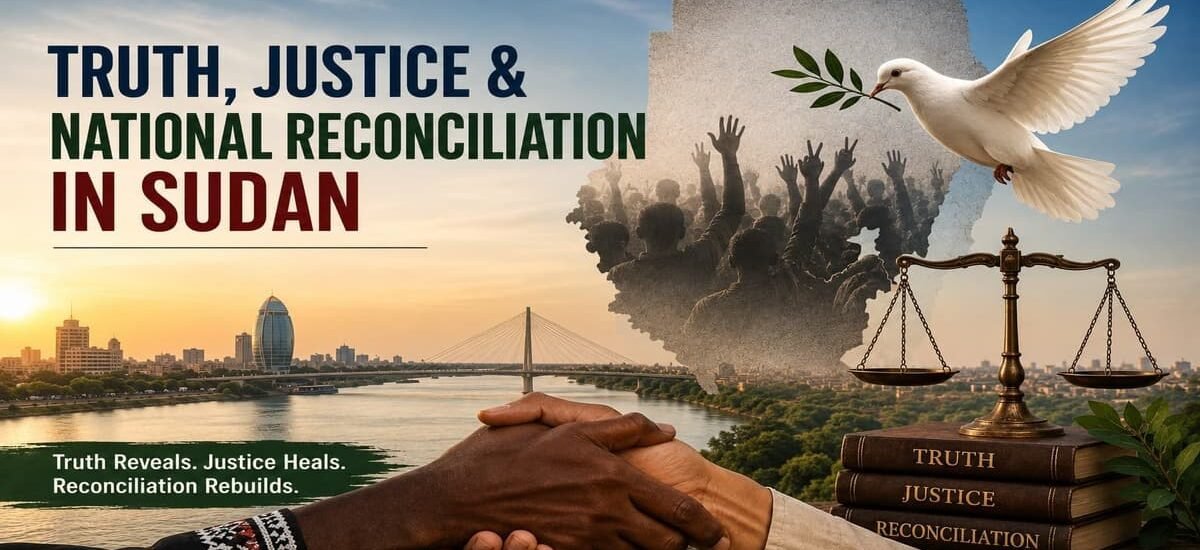
Truth, Justice, and National Reconciliation in Sudan: A Path Toward Lasting Peace
Why Truth Alone Is Not Enough for National Reconciliation
When societies emerge from periods of violence, conflict, and human rights violations, one critical question always arises: Can a nation truly heal without confronting the truth?
As I reflect on Sudan’s ongoing struggle for justice and peace, I believe that uncovering the truth is an essential first step toward national reconciliation. However, truth alone is not enough. While gathering evidence, hearing witnesses, and establishing facts through judicial processes are necessary components of transitional justice, they cannot by themselves achieve genuine reconciliation.
For communities that have suffered deeply—such as the Masalit people and other victims of historical injustices—the wounds of the past require more than legal investigations. True reconciliation demands acknowledgment, accountability, and a sincere commitment to repairing the harm that has been done.
A lesson from many post-conflict societies around the world is that sustainable peace emerges not only from courtrooms but also from moral responsibility, public recognition of wrongdoing, and meaningful efforts to rebuild trust.
Understanding the Concepts of Truth and National Reconciliation
What Does Truth Mean in Transitional Justice?
In the context of transitional justice, truth refers to the comprehensive and accurate disclosure of facts surrounding serious human rights violations and international crimes.
From my perspective, truth-seeking involves more than identifying perpetrators. It requires understanding:
Identifying Those Responsible
- Who committed the violations.
- Which institutions or individuals were involved.
- The extent of their responsibility.
Understanding Context and Motives
Truth also requires examining the political, social, and historical circumstances that enabled violations to occur.
Measuring the Harm Done
A complete truth-seeking process should document the scale of suffering experienced by victims and affected communities, ensuring that their experiences become part of the national record.
Without this comprehensive understanding, societies risk repeating the mistakes of the past.
What Is National Reconciliation?
National reconciliation is a multidimensional process that combines legal, political, and social efforts to rebuild relationships between citizens and the state.
In my view, reconciliation is not simply about ending a conflict. It is about creating the conditions necessary for people to live together peacefully and with mutual respect.
Its legal foundation often includes mechanisms such as:
- Identifying those responsible for violations.
- Establishing independent and impartial judicial institutions.
- Ensuring perpetrators appear before competent courts.
- Securing confessions and acknowledgments of wrongdoing.
- Respecting conditions established by victims in pursuit of justice.
However, reconciliation extends far beyond individual cases. It addresses the broader relationship between a nation and communities that have experienced systematic discrimination, violence, or exclusion.
The Relationship Between Justice and Reconciliation
Why Accountability Matters
One of the most important lessons I have learned from studying transitional justice is that reconciliation without accountability is often fragile.
Many countries have attempted to move forward by ignoring past abuses. In most cases, unresolved grievances eventually reappear, creating new cycles of instability and violence.
For this reason, national reconciliation must include:
- Full disclosure of the truth.
- Accountability for those responsible.
- Institutional reform.
- Reparations for victims.
- Preservation of collective memory.
A Global Example
South Africa’s Truth and Reconciliation Commission is frequently cited as an example of balancing truth-telling with reconciliation. While the process was not perfect, it demonstrated the importance of public acknowledgment and victim participation in national healing.
Similarly, other post-conflict societies have shown that sustainable peace becomes difficult when justice is postponed or ignored.
Principles of Effective National Reconciliation
To achieve meaningful and lasting reconciliation, several fundamental principles must guide the process.
1. Justice Must Come First
True social peace cannot be achieved without justice. Victims deserve fairness, recognition, and accountability for the crimes committed against them.
2. Forgiveness Should Not Erase Memory
Forgiveness can be a powerful human value, but it should never require victims to forget their suffering or erase historical realities.
3. Recognition Is Essential for Healing
The effects of persecution and violence can only be addressed through acknowledgment and corrective action—not through silence or denial.
Truth-Seeking Mechanisms for Transitional Justice
A comprehensive understanding of past violations requires multiple truth-finding mechanisms.
Documentation and Historical Records
Systematic documentation helps establish an accurate historical record of crimes and injustices.
Independent Criminal Investigations
Investigations conducted through impartial judicial institutions strengthen public trust and support accountability efforts.
Encouraging Perpetrator Confessions
Voluntary confessions can help uncover hidden facts, acknowledge responsibility, and contribute to healing.
Using Scientific and Modern Evidence
Modern forensic techniques and scientific methods can provide credible evidence that supports truth-seeking and justice processes.
Essential Conditions for National Reconciliation in Sudan
Based on my analysis, genuine national reconciliation in Sudan requires several critical conditions.
Establishing Comprehensive and Just Peace
Peace agreements must address the root causes of conflict, including political exclusion, ethnic discrimination, and the misuse of religion in state institutions.
Building a Democratic Constitutional System
A democratic government that reflects the will of the people is essential. Victims and affected communities must be represented in decision-making processes.
Cooperating with International Justice Mechanisms
Sudan should fulfill its legal obligations by cooperating with relevant international accountability institutions and mechanisms.
Official Recognition of Violations
The state must formally acknowledge serious human rights violations and international crimes committed against its citizens.
Offering Formal Apologies to Victims
Public apologies can play a powerful symbolic role in recognizing suffering and restoring dignity.
Reforming Security Institutions
Security sector reform is necessary to eliminate abusive practices and address the challenge of irregular armed groups.
Ensuring Safe Return of Displaced Persons
Refugees and internally displaced persons must be guaranteed safe, voluntary, and dignified return to their communities.
Promoting Social Justice
Both distributive and compensatory justice should be implemented in ways that respect human rights and protect vulnerable groups, especially women and children.
Key Stakeholders in the National Reconciliation Process
National reconciliation involves several interconnected relationships.
Victims and the State
Rebuilding trust between victims and state institutions is essential for long-term stability.
Victims and Affected Communities
Reconciliation efforts should strengthen social cohesion and encourage peaceful coexistence among communities.
Victims and Perpetrators
Where appropriate, structured processes of accountability, acknowledgment, and restorative justice can contribute to healing.
Balancing Justice, Forgiveness, and Trust
One of the greatest challenges in reconciliation is finding the balance between justice and forgiveness.
In my view, sustainable peace cannot exist without justice. At the same time, societies must create opportunities for rebuilding trust and fostering coexistence.
This balance requires:
- Recognition of wrongdoing.
- Accountability for violations.
- Respect for victims.
- Institutional reform.
- Commitment to preventing future abuses.
Without these elements, reconciliation risks becoming a temporary political arrangement rather than a lasting foundation for peace.
Conclusion: Building Lasting Peace Through Truth and Accountability
National reconciliation is far more than a political settlement. It is a long-term process of rebuilding trust between citizens, communities, and the state through truth, accountability, acknowledgment, and reparations.
From my perspective, experience has consistently shown that ignoring violations does not erase them. Instead, unresolved injustices often reappear in new forms of conflict and violence.
For Sudan to achieve lasting peace, there must be a genuine commitment to confronting the past, delivering justice to victims, reforming institutions, and ensuring that violations never happen again.
Ultimately, true reconciliation is not built on forgetting. It is built on recognition, accountability, justice, and living memory. Only through these principles can Sudan establish a future grounded in human dignity, the rule of law, and peaceful coexistence.
